How to Deliver In-Situ AI Inspection as a Machine Capability
Date Section Blog
The previous articles explored the commercial impact of inspection decisions for process equipment OEMs. They examined the strategic shift happening across advanced manufacturing, where defect qualification timing increasingly influences customer yield and the perceived machine value. And why in-situ classification is becoming critical before hybrid bonding.
That shift was quantified through the hybrid bonding business case. The representative scenario showed how pre-bond classification decisions influence false scrap and downstream yield economics.
The next question is delivery: what does it take to turn in-situ AI inspection into a machine capability OEMs can productize?
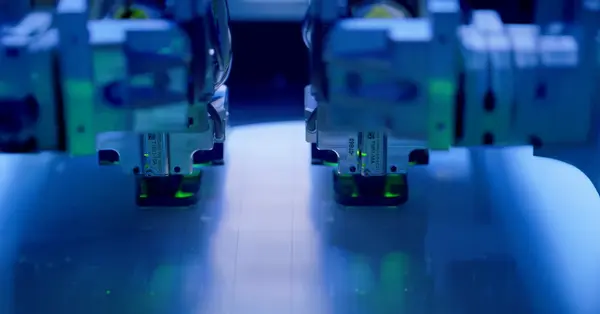
For many OEMs, the technical starting point already exists. Process tools often generate rich visual data at the moment decisions matter. Sensors capture surface images. Inspection modules detect anomalies. Process context is already available. What they often lack is an operational intelligence layer that transforms inspection signals into structured decision evidence inside the equipment workflow.
That gap is where Robovision operates. Rather than treating AI as a standalone software layer, Robovision enables OEMs to embed production-grade industrial vision intelligence directly into machine capability. Beyond automating classification, the solution delivers a governed decision evidence layer that strengthens machine differentiation while creating a foundation for future process intelligence.
Adding Decision Intelligence to Existing Imaging Capability
Adding AI to a machine sounds like a straightforward solution. However, production environments impose very different requirements from proof-of-concept automation. A classifier alone does not create a deployable OEM capability. The real challenge is operational reliability.
The decision intelligence layer must run at process speed, integrate with existing machine workflows, maintain traceability, adapt as production conditions evolve, and operate within the governance expectations of highly controlled manufacturing environments. Which is where internal build discussions get complicated. Developing a model is one challenge. Delivering a validated machine capability that customers trust in production is another.
Robovision addresses the full delivery problem through its industrial vision intelligence infrastructure that operates within the machine environment. Within that, a governed decision evidence layer turns inspection outputs into structured decision evidence that supports process actions in real time.
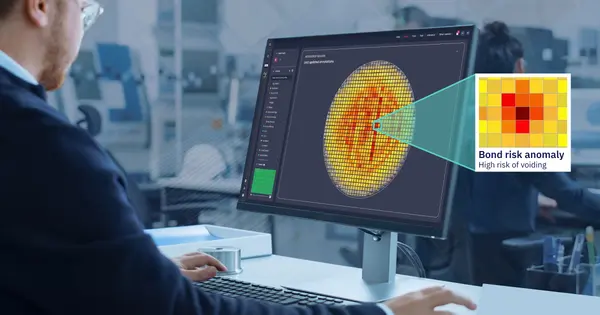
Depending on the workflow, that could mean:
- Qualifying a surface for bonding
- Triggering a clean-and-retry path
- Escalating ambiguous conditions for review
- Identifying process behaviour that requires intervention
The machine moves beyond observation to evidence-based . Delivering that capability in production, however, requires a practical deployment model. The intelligence must operate inside existing manufacturing environments without introducing architectural disruption. Robovision solves this through an intelligence layer that integrates within existing machine workflows.
The Intelligence Layer Inside the Tool
Robovision’s industrial vision intelligence infrastructure is deployed at the edge, close to the process, where low-latency qualification is required. It allows inspection data to be interpreted within the equipment workflow itself, without the need for external dependency or a human-in-the-loop for routine decisions.
The Core Capability Stack
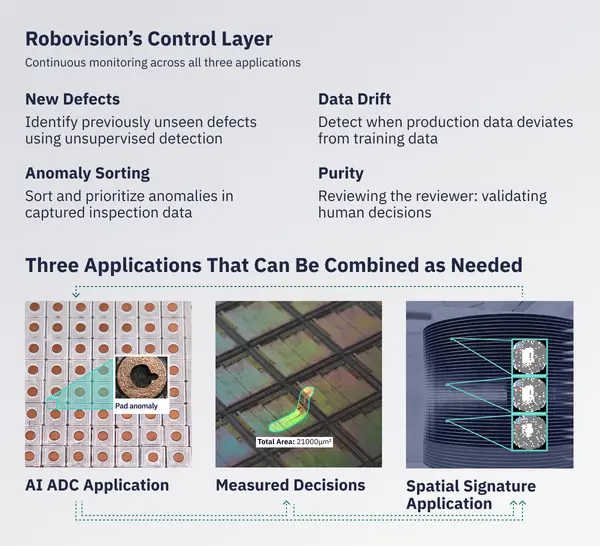
This decision layer is built on three core applications: AI-driven automatic defect classification (AI ADC), defect measurement, and spatial signature (cluster recognition):
AI-driven automated defect classification
Robovision’s AI-driven automated defect classification enables equipment to distinguish between known defect conditions according to customer-approved operational logic.
In a hybrid bonding workflow, for example, this may mean separating particle contamination from scratches or differentiating acceptable variation from surfaces that require intervention. Classification ambiguity is reduced at the exact point where process decisions are made. So instead of routing every suspect condition into manual interpretation or conservative rejection logic, the machine applies consistent qualification criteria at production speed.
For OEMs, this increases product value by improving qualification confidence at the point where process risk is highest.
Defect measurement through segmentation
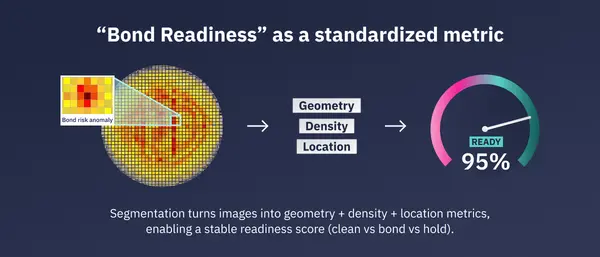
Classification often answers what a defect is, and segmentation adds the operational context needed to determine what should happen next. By measuring size, geometry, density, and position, segmentation converts images into quantifiable process intelligence.
In the hybrid bonding example, defect location and physical characteristics directly influence bonding readiness. Rather than simply identifying contamination, the machine can assess whether a surface meets qualification criteria, requires cleaning, or should be held. This capability creates the foundation for structured surface qualification and confidence-based process decisions. Over time, it also supports the development of standardized metrics such as bond-readiness scoring, enabling OEMs to position their machines around measurable process assurance rather than inspection capability alone.
Spatial signature and process intelligence
Some manufacturing issues only become visible when patterns are analyzed over time. Spatial signature analysis extends machine intelligence from individual classification into broader process awareness.
Recurring defect clusters, directional signatures, contamination density trends, and repeated spatial patterns can indicate cleaning inefficiency, tool behaviour, or emerging drift conditions. Known defect classification addresses expected conditions, but production environments also evolve. Robovision’s hybrid AI approach combines automated classification with anomaly detection, helping OEMs surface novel defect behaviour and drift-critical changes as process complexity increases.
Together, these capabilities turn inspection outputs into richer operational decision evidence. Instead of forcing every suspect condition into a single binary interpretation, machines generate evidence that includes ranked classifications, confidence signals, anomaly awareness, and broader process context to support more precise review routing and escalation. Final production decisions remain governed by existing manufacturer quality workflows.
For OEMs, this capability expands the machine’s role beyond inspection support. The same intelligence layer that supports in-situ qualification today can evolve into a differentiated operational intelligence capability across the installed base.
Ready to turn inspection intelligence into product advantage? Let’s talk.
The Production Control Layer
Industrial customers evaluate embedded intelligence as part of machine performance. Because of this, every automated decision must be controllable, traceable, and operationally reliable.
Robovision provides the production controls required to make embedded AI commercially deployable, including:
- Model version traceability
- Confidence threshold governance
- Drift detection
- Anomaly capture
- Controlled retraining workflows
- Traceable decision and audit records
- Performance visibility
Known defect classification solves only part of the production problem. Novel defect behaviour and emerging drift conditions also need to be detected, surfaced, and governed. If operating conditions shift, the system identifies the change. If novel defect behaviour appears, it can be surfaced for investigation. If recalibration is required, it happens through a governed lifecycle rather than uncontrolled model drift.
These controls matter as much commercially as they do technically. Reliable governance reduces customer adoption risk and strengthens confidence in the OEM offering.
Built Around Existing Manufacturing Architecture
Operational control makes embedded AI technically credible. Deployment architecture determines whether it is commercially practical. OEM adoption often stalls when AI is perceived as disruptive infrastructure.
Robovision supports OEM deployment through a service framework that reduces adoption risk while creating long-term commercial upside. The decision evidence layer integrates within existing machine and customer environments, preserving established manufacturing ownership rather than replacing it. Class-to-bin logic stays customer-controlled where required.
Inspection systems continue performing their existing role, and factory systems continue controlling broader production logic. Robovision enables machine-level decision evidence, which creates the greatest operational value. From an OEM perspective, deployment is more practical across diverse customer environments. And for those working alongside inspection vendors, OSATs, or integrated manufacturers, Robovision enhances the ecosystem rather than forcing architectural replacement.
Reducing deployment friction solves the adoption challenge. The next consideration is how that capability is delivered, supported, and monetized over time.
From Deployment Success to Recurring SLA Revenue
Embedding intelligence into a product requires more than successful deployment. A tool does not become production value the moment capability exists. Once feasibility is proven, performance, reliability, and operational fit must be validated before productization. Robovision structures embedded AI delivery around this. A staged service model reduces adoption risk while supporting long-term operational value.
The Development SLA is designed to validate capability before productization. Models are trained, thresholds optimized, workflows validated, and performance measured against relevant operational metrics. OEMs have evidence before productization decisions are made.
Once validated, the relationship transitions into a Production SLA that sustains production performance through lifecycle management. Monitoring, drift detection, recalibration, governance, and operational support become structured service commitments that create an important commercial advantage.
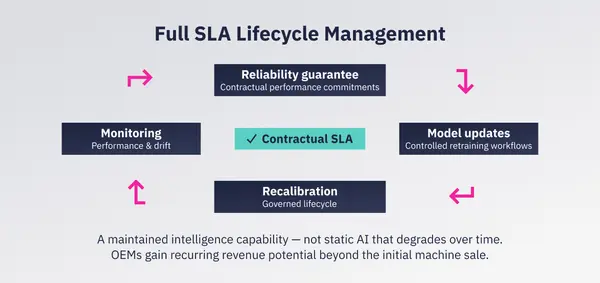
Rather than shipping static AI functionality that degrades over time, OEMs deliver a maintained intelligence capability backed by contractual performance commitments. They benefit from a differentiated service proposition with an opportunity to introduce recurring revenue beyond the initial machine sale.
The immediate value is clear. The longer-term opportunity is what the installed intelligence base enables next.
What Embedded Intelligence Enables Next
The immediate value of in-situ intelligence is better machine-level qualification. The longer-term opportunity is broader. As more tools contribute operational surface data, the decision evidence layer becomes more informed. As this expands across process steps, pre-process surface signals can be correlated with downstream outcomes such as bonding quality, void formation, or yield loss. Cross-equipment learning improves model quality, process signals become more predictive. Surface qualification evolves into process intelligence. For applications such as hybrid bonding, this opens a clear progression from defect classification toward adaptive process control, predictive intervention, and a tighter link between inspection behaviour and yield outcomes.
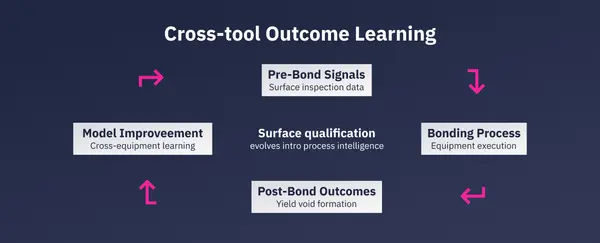
That future does not need to be built all at once. The priority is establishing the governed intelligence layer that makes both current product differentiation and future process intelligence possible.
A Clear Path to Productized Decision Intelligence
Many machines already generate the right signals. The competitive opportunity lies in transforming those signals into structured decision evidence and operationalizing that intelligence as part of the product. The challenge? Delivering a governed, production-ready capability that customers trust, operational teams can maintain, and commercial teams can position as differentiated machine value.
Robovision enables OEMs to move beyond experimental AI development and introduce embedded intelligence as a validated machine capability. Support is offered through ongoing lifecycle management and operational governance, backed by defined service commitments. Instead of inheriting the burden of internally maintaining AI infrastructure, OEMs bring a production-ready capability to market with performance accountability built into the commercial model.
The result is stronger product differentiation combined with recurring service potential, and a practical route to shipping in-situ intelligence as part of the machine itself.
The Operating Model for Productized In-Situ Inspection
How do OEMs make embedded AI commercially deployable? Our tech brief explains the production controls needed for a governed in-situ decision evidence layer that strengthens machine value and customer trust.
