Closing the Pre-Bond Gap With In-Situ Classification
Date Section Blog
The previous article explored how yield loss is shaped by decision evidence and why process tools are the point where those decisions matter most. It examined how adding a governed decision intelligence layer to in-situ inspection enriches signals with contextual evidence, to support more consistent production decisions.
Hybrid bonding brings that shift into focus.

Surface condition is no longer a parameter to optimize. At the bond interface, acceptable variation effectively disappears. A single particle or micro-defect at the interface can prevent a successful bond, compromising an entire stacked structure. Unlike earlier process steps, this is not recoverable. Once bonded, the defect is locked in and the cost multiplies.
This situation makes hybrid bonding one of the clearest examples of a broader shift for semiconductor process equipment OEMs: as process tolerances tighten and downstream value increases, earlier defect qualification becomes commercially more important. For OEMs whose tools influence surface condition or defect disposition before critical process steps, the role of embedded inspection is changing. Beyond preparing the surface, tools must now provide the decision evidence needed to determine whether that surface is fit to proceed.
In this article we explore why in-situ classification is becoming critical before hybrid bonding. We examine the commercial impact of evidence-backed surface qualification before bonding, and how it changes the role of the pre-bond tool.
Zero Tolerance Means Zero Uncertainty
In most flows today, pre-bond inspection does not operate at that level of certainty. Most pre-bond tools still rely on sampling strategies or external inspection dependencies for surface evaluation. Wafers are checked intermittently or routed to separate AOI stations for review. These approaches provide visibility, but not completeness.
For example, sampling introduces statistical risk. A wafer that is not inspected is a wafer that is assumed to be acceptable. Separate inspection introduces latency. By the time a defect is detected, the process has already moved forward, or the feedback loop is too slow to influence real-time decisions.
In hybrid bonding, both approaches fall short. The requirement is no longer for visibility across the flow, but for evidence-based assessment at the interface. For pre-bond equipment builders, this changes what the upstream tool is expected to deliver.
What Classification Ambiguity Means at the Bond Interface
The gap lack of structured decision evidence to interpret surface conditions consistently before bonding. When surface defects cannot be confidently categorized, classification ambiguity soon becomes a bond failure risk because the pre-bond tool is limited in how it responds. Bond-ready wafers may be removed as a precaution, while others proceed with unresolved uncertainty at the interface.
At this stage, the impact is immediate:
- Particles and residues translate directly into bonding failures
- Process conditions become more constrained to compensate for uncertainty
- Interconnect reliability risk increases
As a result, the capability of the upstream tool increasingly influences bond integrity outcomes.
Interconnect Reliability Becomes the Yield Constraint
Advanced packaging is shifting where yield is determined. As architectures move toward HBM stacking, chiplet integration, and ultra-fine interconnects, the critical factor is how reliably components are connected. In this environment, upstream tools increasingly influence interconnect reliability outcomes.
These interfaces are irreversible. They are highly sensitive to surface defects and represent high-value structures within the final package. A single misclassified surface anomaly at this stage can invalidate the entire assembly.
The pre-bond tool is now determining whether the interconnect can succeed, which changes the role of upstream equipment. To operate under these conditions, surface evaluation must move beyond detection.
What is required is the ability to:
- Validate bond readiness before bonding
- Generate evidence-backed bond qualification
- Detect early signs of process drift
- Reduce classification ambiguity
- Support pre-bond confidence-based decisions
Achieving this turns surface inspection into interconnect risk intelligence. In-situ classification at the pre-bond tool, backed by evidence, enables this shift. It connects surface condition directly to bonding outcomes, at the point where decisions are made. However, enabling that connection depends on how those surface signals are interpreted and acted on within the tool.
The Missing Step Before the Bond
When integrated directly into the pre-bond tool, in-situ inspection evaluates every wafer as part of the process itself. And when a governed decision intelligence layer is added, surface signals are turned into structured decision evidence. Classification happens before the wafer progresses downstream.
As a result, the dependency on sampling is removed. In-situ removes the delay introduced by external inspection. More importantly, it shifts interface assessment from a probabilistic process to a deterministic one. Every wafer is assessed using the same evidence-based qualification process, and every decision is made at the point of action.
Ready to shift your tool from surface preparation to bond-readiness control? Let’s talk.
Enhancing Detection With Evidence-Backed Decisions
At the image level, critical defects can appear similar to benign surface variation. Without a reliable way to distinguish between them, decisions tend to become conservative. Wafers are removed to avoid risk, or allowed through with uncertainty still unresolved.
Embedding AI-driven classification into the pre-bond tool closes this gap. Signals are turned into contextual decision evidence to help qualify bond readiness. Surface data is interpreted in context, not just captured, and defects are classified in real time.
Beyond observing surface condition, the tool generates the decision evidence needed to qualify bond readiness consistently at production scale, turning the pre-bond step into a control point for bond integrity.
From an OEM perspective, this changes how upstream equipment is evaluated within advanced packaging flows.
The Business Impact of Pre-Bond Classification
A pre-bond tool with embedded decision evidence intelligence influences how the product is defined. The difference is measurable at the customer level, where yield outcomes are linked to bond integrity and downstream yield performance. For OEMs, this creates a specification-level distinction. The capability becomes part of how the tool is positioned, differentiated, valued, and selected within advanced packaging flows.
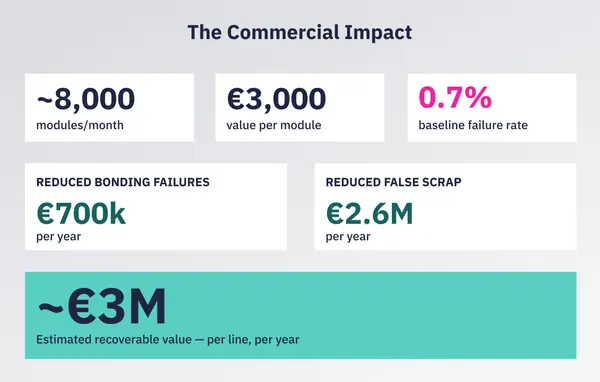
The commercial relevance increases as bonding structures become more valuable and process tolerances continue to tighten. Small improvements in classification accuracy can translate into measurable customer yield recovery, turning tool capability into a production advantage. A representative high-volume scenario illustrates the scale of impact:
- ±8,000 modules are processed per month
- The bonding step contributes ±€3,000 in value per module
- Particle-related bonding failures occur at ±0.7%
Under these conditions, improving qualification accuracy significantly reduces particle-induced bonding failures. A conservative assumption of a 35% reduction results in approximately €700k annual recovery per bonding line.
Reducing false scrap before bonding creates additional upside. For example:
→ 3% of surfaces flagged pre-bond
→ 60% particle-related
→ 50% conservatively scrapped
This results in the recovery of approximately 72 modules per month. At current value contribution, this represents roughly €2.6M annually.
Combined, these effects result in an estimated ±€3M per line, per year in recoverable value. The ability to influence measurable customer outcomes at the bond interface changes how the tool participates in the production flow and how its value is commercially evaluated.
Proving Value Before Productization
Introducing in-situ classification requires validation within the context of the specific tool and process. Surface conditions, defect types, and process sensitivities vary across applications. The classification layer must be trained and validated against real production data to ensure it performs as required.
This requirement is where a Development SLA becomes critical. It allows OEMs to deploy and evaluate in-situ inspection within their own environment, using their own data, before committing to it as a product feature. Performance can be measured and aligned with process requirements, replacing theoretical outcomes with validated capability.
Where Bond Success Is Defined
Hybrid bonding does not leave room for uncertainty at the interface. The decision to proceed is a decision that impacts bond success.
For equipment OEMs, that decision is moving upstream. The ability to evaluate every surface, turn inspection signals into structured decision evidence, qualify bond readiness consistently, and support real-time process action defines whether the tool participates in the process or controls its outcome.
Because of this, the specification begins to shift. Surface preparation alone is no longer sufficient. The expectation is moving toward tools that qualify surfaces using evidence-backed decisions before bonding, reducing both avoidable failures and unnecessary scrap.
At scale, even small improvements in classification accuracy translate into measurable commercial impact across each bonding line.
The Hybrid Bonding Business Case
Hybrid bonding is a compelling case for in-tool classification. View our representative business model to see how embedded inspection intelligence turns defect decisions into €3M/bonding line/year.
