The Untapped Yield Leverage Inside Process Tools
Date Section Blog
For semiconductor equipment OEMs, yield is no longer defined at the end of the line. It is determined by defect decision timing. In many cases, process tools already capture the relevant signals. What is missing is the decision evidence to turn that data into decisions within the process tool, at the point where defects are created.

Defect cost compounds with every process step it survives. When classification and disposition are delayed, defects move through higher-value stages and increase their impact on yield. In-situ tools acting at defect origin turn existing data into real-time classification and disposition that define yield outcomes.
This capability closes the gap between when a defect is created and when it is acted on. It also changes how tools are evaluated in production. Performance used to be defined solely by process execution; now it is linked to measurable yield outcomes.
This article examines where that influence is created, and how it is shaped by defect decisions made within the process.
Defect Decision Timing Defines Yield Outcomes
In semiconductor production, yield loss is tied to the timing of defect decisions. Inspection systems already identify anomalies across the process. Even so, defects continue through the flow and affect final output. For OEMs, this changes how tool performance is assessed in production environments. Process equipment is increasingly evaluated on its contribution to yield, alongside its role in executing a process step. The challenge is providing sufficient contextual evidence to make consistent decisions from those signals, as early as possible.
Even using a conservative wafer value of €1,000, the cost of late-stage defects is significant. For advanced-node wafers, the financial impact can be substantially higher, making the impact of late-stage defects more pronounced. Increasing manufacturing complexity pushes costs higher. Leading-edge design costs have risen from around $15 million at 90nm to more than $1 billion at 3nm, highlighting the growing cost of advanced-node development. These pressures compound the impact of defects as they move downstream, where yield loss translates directly into high-value scrap. The issue lies in how and when those signals are acted on.
These challenges are particularly critical in applications such as automotive and power devices, where reliability requirements further reduce tolerance for defect-related variation. The pressure intensifies at advanced nodes. Smaller geometries increase sensitivity to defects, and the margin between acceptable variation and yield impact reduces.
When classification and disposition happen later in the process, defects move through higher-value steps before a decision is made. Defects that had limited impact can affect downstream process integrity or device performance when allowed to propagate. At that stage, the impact on yield is greater and recovery options are limited, introducing a structural form of yield loss.
The Real Bottleneck Is Decision Uncertainty
Visibility into potential defects is not the limiting factor. Many process tools already capture large volumes of surface and process data. The challenge begins after detection, at the point where the tool must determine whether the signal is actionable.
Surface anomalies do not always map clearly to outcome. Differences in morphology can be subtle, and process sensitivity varies depending on the step. In many cases, it is difficult to determine whether a signal represents acceptable variation or a yield-impacting defect. Classification remains uncertain because the evidence required to support disposition is incomplete, and the tool cannot act on the data it captures. It observes the condition, but does not close the loop on it. As a result decisions are delayed, escalated to external inspection, applied at lot level, or default to conservative operating assumptions. The tool observes the condition, but does not close the loop on it. At the OEM level, this gap exists within the tool’s operating context. It sits at the point where the wafer is already being processed.
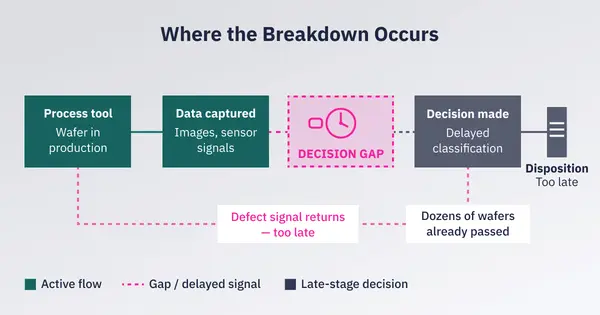
Detection already performs its role. The issue is the absence of decision evidence to translate captured signals into immediate, reliable decisions at the point of action.
When classification remains uncertain, the customer carries the burden of interpretation, review, and risk management downstream. This risk changes how they evaluate tools. It also affects how equipment performs during qualification, and how it integrates into production flows.
For OEMs, the impact is commercial as well as technical. In advanced packaging environments, customers expect process tools to contribute to yield outcomes within the process itself, not simply generate additional inspection data for downstream interpretation. A tool that generates surface data without enabling confident decisions risks being evaluated as incomplete, relative to evolving process expectations.
Ready to strengthen your tool’s role in customer production flows? Let’s talk.
Closing the Loop Inside the Tool
An in-situ decision evidence layer addresses this risk by embedding classification and disposition intelligence directly within the process flow. Defects are evaluated and acted on where they occur, using process-contextual data already captured by the tool. Dependency on delayed review paths is removed, allowing decisions to happen at the point of action. Rather than simply generating classifications, the tool provides ranked outcomes, process-contextual evidence, and auditable decision support at the point of defect origin.
Acting at this stage reduces unnecessary wafer removal. It limits the downstream propagation of yield-impacting defects and enables process tools to contribute more directly to yield outcomes.

At this point in the process, classification can be performed within the tool context and used to support immediate disposition. For OEMs, this extends the tool’s role without adding a separate downstream inspection step.
The tool moves beyond observing process conditions to participating in real-time process control and decision-making. The result is a measurable shift in how the equipment contributes to production performance.
The Commercial Impact for OEMs
Customer expectations around process equipment are constantly evolving. Tools are assessed based on their contribution to yield, alongside traditional performance metrics. When a tool supports yield improvement:
- Its value in production increases
- Its role within the process becomes more central
- Its position in the customer environment strengthens
This development reinforces the importance of core hardware capability by linking it more closely to business outcomes. It also creates an opportunity to extend value over time.
Capabilities that operate at the decision layer can be:
- Introduced after installation
- Adapted to process changes
- Aligned with specific customer requirements
In doing so, OEMs can create a pathway to extend value beyond the initial tool deployment, with an opportunity to strengthen differentiation while building on existing platforms.
Transitioning Toward Real-Time Decisions
Detection systems identify anomalies early in the process. Process tools execute manufacturing steps with precision. The missing piece is decision evidence at the point where defects occur. An in-situ inspection intelligence layer may be the best next step, turning known defect patterns into real-time disposition at the point of origin.
For OEMs, this creates a direct link between tool capability and yield outcomes in customer environments.
In the next article, we examine how in-situ evidence is being applied in hybrid bonding, where pre-bond defect decisions directly influence downstream yield and tool value.