Bridging the Decision Gap Between Inspection and Yield
Date Section Blog
We already established that yield loss is not driven by missed defects, but by how anomalies are reviewed under uncertainty. Our first article explored this shift. Then, we quantified the financial impact in our second article, showing that decision uncertainty creates a multimillion-euro yield gap.
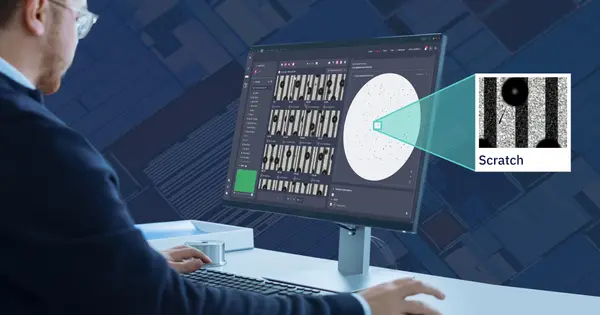
The question now is what comes next. How do fabs bridge the gap between decisions and yield loss? What does a scalable, production-grade decision model actually look like? And how can fab expertise be applied at scale, without increasing risk or operational complexity?
This article explores the missing evidence layer between inspection and yield. It shows how Robovision turns inspection signals into structured decision evidence that supports auditable, more consistent production decisions.
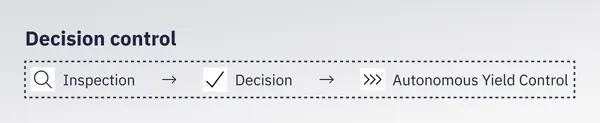
The Shift From Inspection to Decision Control
AOI systems have advanced and generate vast volumes of inspection data. But this exposes a new constraint. Human review must interpret that data under uncertainty, and at a scale it was never designed to handle.
The challenge is now achieving consistency in the decisions made after inspection.
To achieve this, fabs are moving from detection toward evidence-backed decisions. Where inspection signals are turned into structured evidence that supports measurable and governed actions. And this is where Robovision specializes.
Ready to improve review consistency at scale?
A Unified Review and Learning System
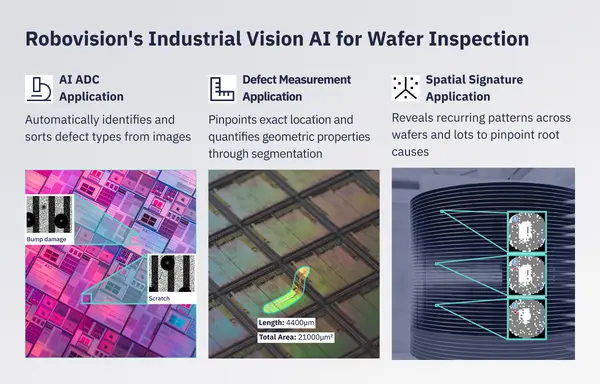
Robovision’s Industrial Vision Intelligence Infrastructure delivers a decision layer built on three core applications: AI-driven automatic defect classification (AI ADC), defect measurement, and spatial signature (cluster recognition). Together, they form a unified system that classifies defects and continuously improves how decisions are made.
Inspection outputs are translated into structured decision evidence that guides process actions. Review flows remain fully traceable, and knowledge can be reused across tools, lines, and sites.
While these recipes can be optimized individually, the value comes from how they operate together. These applications form a system where decisions improve over time. Each one builds on the last, adding a new layer of intelligence. AI ADC classifies defects. Measurement extends this with precise sizing and localization. And spatial signature analysis goes further, applying that intelligence across wafers to reveal patterns and context at scale.
AI ADC Application: Increasing Yield With 100% Review Coverage
AI ADC enables scalable defect classification, reducing manual review effort while improving decision consistency. By filtering out nuisance defects and accurately classifying defects of interest (DOIs) at the optical stage, it reduces the SEM bottleneck. Review capacity can focus on critical defects, preventing production release delays.
Inspection data is ingested through intelligent image import, including KLARF and wafer map context, with the ability to capture DOIs as conditions evolve. An optimized classification model classifies defects at scale, supported by human-versus-model checks to maintain quality.
Prediction threshold optimization allows teams to balance yield recovery and risk by managing overkill (false positives) and escapes (false negatives). In parallel, data drift detection monitors whether incoming data still matches training conditions. When drift is identified, outliers are captured, reviewed, and used to retrain the model, ensuring adaptability and performance stability over time.
The result is a classification process that requires less human input and provides operations intelligence through continuous monitoring, supporting yield improvement at scale.
Defect Measurement Application: Linking Decisions to Defect Size
Defect Measurement enables consistent, threshold-based decisions by quantifying defects against predefined tolerances.
Through intelligent data capture, segmentation models localize defects and generate precise masks. These are linked to area-based thresholds, enabling decisions to be triggered based on measurable criteria rather than subjective interpretation.
An adaptable confusion matrix allows classification logic to be tuned to different production contexts, while outputs remain connected to post-processing and downstream workflows. Continuous monitoring ensures decisions stay aligned with process requirements.
Reliance on manual input is reduced, with improved model quality and more consistent decision-making supported by deployment intelligence and dashboarding for visibility and control.
Spatial Signature Application: Pattern Recognition and Adaptive Classification
Spatial Signature extends classification by identifying similarities and patterns across defects and wafers. The value is to get a better understanding of where in the process the defects started. For example, if the defect is a recurring scratch on the same location across wafers, operators know this might be caused by a mechanical signature, while randomly distributed defects may point to ambient contamination (e.g. cleanroom events such as HEPA filter failure).
Through intelligent image import and few-shot learning, defects can be grouped based on similarity. New or ambiguous defect types can be understood with limited labeled data. Optimized classification models support scalable classification, with ground truth verification ensuring quality.
Threshold optimization helps operators monitor whether the data the model sees is the same data it was trained on (detect data drift), and capture the ones most relevant to make the model better over time (efficient re-training).
Together, these applications create a system that reduces manual effort and maintains model quality. They provide operations intelligence through continuous monitoring, enabling more adaptive and scalable decision-making and turning previously hidden yield loss into measurable, recoverable value.
A Shared Workflow Across Applications
These applications operate within the same workflow and can be combined as needed.
At the core is inference, where inspection data is processed through pre-processing, model execution, and post-processing. Inspection signals are turned into structured decision evidence. On top of this, intelligent review surfaces data drift and defects of interest, allowing teams to focus on what matters most.
A shared workflow only scales if decisions remain controlled, consistent, and continuously improving.
Manual review remains part of the process, but becomes targeted. Edge cases and new conditions are sampled and validated, then fed back into the system to improve future performance. The result is a closed loop between inspection, review, and learning, where decisions become more accurate and scalable over time.
For this loop to operate at scale, maintaining control of it becomes critical. Robovision embeds a control layer within the workflow to monitor data drift, surface new defect patterns, prioritize anomalies, and validate both model and human decisions.
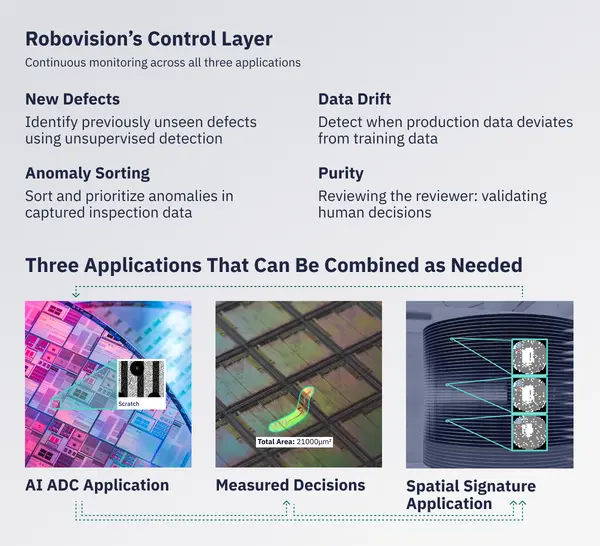
This control layer operates continuously alongside the review workflow, so decision-making remains consistent and governed as it scales across the fab.
Supporting Fab-Wide Decision-Making
Achieving consistent, full-coverage review is a question of usability across the different roles involved in defect review and decision-making.
Review decisions are not made by a single user group. Process engineers, operators, and management each interact with inspection data in different ways. Traditional approaches often fragment these interactions, introducing variability between tools and shifts, and across sites and fabs.
A unified review layer removes this fragmentation by providing role-specific interfaces on top of a shared decision foundation.
For Process and Yield Enhancement Engineers
Advanced interfaces support classification, defect measurement, and spatial analysis, enabling deeper investigation and model refinement. They provide a more structured understanding of defect behaviour across wafers and lots.
For Operators
Deployed models run directly at the machine level, where operators interact with them in real time. Pre-configured single or multi-model recipes process inspection results without adding complexity to existing workflows.
For Management
Centralized dashboards, KPIs, and alerting provide clear visibility into performance and decision patterns, together with operational impact across the fab.
Across all roles, the same underlying decision evidence, data, and logic are used. Decisions stay consistent and traceable. In parallel, intelligent data capture supports continuous improvement. By monitoring data drift and binning behaviour along with model performance, the system enables targeted retraining and sustained accuracy over time.
The result is a reliable, scalable review process with consistent decisions made across roles and environments. Inspection scales without introducing new variability or operational risk, and yield is no longer lost to inconsistent or conservative actions.
However, to sustain this improvement at scale, model performance and review processes must be continuously managed and optimized.
Controlled Model Lifecycle and Review Optimization
In most fabs, model performance and defect review are managed separately, making it difficult to trace decisions or adapt to changing conditions.
Robovision manages the full model lifecycle as a controlled, traceable process, from versioning and deployment to performance monitoring and rollback. Models are continuously evaluated in production, ensuring that decision quality remains stable as conditions evolve. At the same time, manual defect review is focused on where it adds the most value, supporting optimization of critical defect classifications. This structured approach combines model performance and human expertise to improve decision outcomes, reducing unnecessary scrap and translating into measurable yield and margin improvement. To maintain this performance over time, AI must operate within a framework that balances control with adaptability.
Production-Grade AI With Built-In Governance
AI in fab environments faces a fundamental trade-off. Systems must meet strict governance standards, yet be flexible enough to adapt to evolving defect patterns.
Robovision closes the gap between industrial reliability and AI flexibility. It combines deterministic, auditable systems aligned with Tier-1 governance standards with hybrid classification and anomaly detection that adapt as conditions evolve. Underpinning this is a Governance & Operational Technology (G&OT) framework that turns vision intelligence into a standardized, audit-ready component, ensuring lifecycle stability and “sleep-at-night” reliability across every site.
Deployment follows a phased approach, where performance is first validated and then sustained in production. During the development phase, a clear business case is established, with impact measured against key indicators such as yield, false positives, and throughput. A defined Development SLA ensures results are relevant to real production conditions.
Once validated, the system transitions into a stable production workflow under an Enablement SLA. Here, performance is maintained and scaled through continuous monitoring, data drift detection, and targeted data capture.
This two-stage SLA model reduces adoption risk by linking deployment directly to ROI. Value is first proven, then sustained. But production-grade AI is not only defined by how it is governed. It is defined by how it fits into the reality of the fab.
Built Around Your Existing Process
Introducing AI into defect review often raises a core concern: can AI improve review decisions while preserving the governance, workflows, and production controls already in place?
Robovision’s AI operates as a secondary review layer, running directly on fab infrastructure and supporting, rather than replacing, existing inspection and decision processes. It works alongside AOI within the existing inspection and review flow to improve how defects are evaluated, without changing how authority is managed or how defects are detected. AOI systems continue to do what they are designed to do.
The difference is that inspection signals are turned into structured evidence before production decisions are made:
- Yield recovery is driven by combining AOI detection with AI-assisted acceptance
- Performance is measured against a controlled false accept rate benchmark
- Decision quality improves while existing safeguards remain in place
- AI does not autonomously release product
- MES remains responsible for class-to-bin mapping
By focusing on the decision layer, Robovision makes existing review processes visible, measurable, and consistent, rather than variable and dependent on individual interpretation. This approach improves decision quality without introducing disruption. Instead of replacing human expertise, it captures and standardizes it, allowing the same logic to be applied consistently across wafers and time.
Human oversight remains an integral part of the process. Auditing is configurable based on production requirements, with reviews carried out by qualified manufacturer experts. Decision-making becomes controlled and auditable, aligned with the same governance standards as process control systems.
The outcome is a safer, more secure way to scale review. Decisions are consistent. Yield impact becomes measurable. Expert knowledge is retained and reused. Fab expertise can be applied at scale without increasing risk or operational complexity.
From Inspection to Measurable Yield Outcomes
The industry does not need more detection. Better decisions, made consistently and at scale, are what is needed to unlock recoverable yield.
By introducing a governed decision intelligence layer, fabs move from reactive to controlled, consistent, auditable, and measurable actions. What was previously hidden in thousands of uncertain decisions becomes visible and actionable. Instead of relying on limited sampling and individual interpretation, fabs make production decisions supported by structured evidence that scales across reviewers, shifts, tools, and sites.
With Robovision, fabs recover good wafers without changing AOI authority. Human audit preserves quality governance, and commercials are tied only to verified recovery. The outcome is a controlled, scalable approach to decision-making that turns hidden yield loss into sustained financial and performance gains.