How to Recover The Multimillion-Euro Yield Gap
Date Section Blog
In our previous article, we discussed how uncertainty in sampling-based manual review leads to conservative decisions. We explored why those decisions result in unnecessary scrap and where operational bottlenecks occur, highlighting how yield loss is driven by how review is performed.
This article moves on to quantify the financial and operational impact of a more scalable review approach, using a representative high-volume production scenario. It shows how sampling-based review structures create structural over-scrap and how a governed decision evidence layer transforms inspection data into structured evidence that supports more consistent, full-coverage review.
The result is recovery at scale: a clear, multimillion-euro yield recovery opportunity, achieved by improving how review decisions are made.
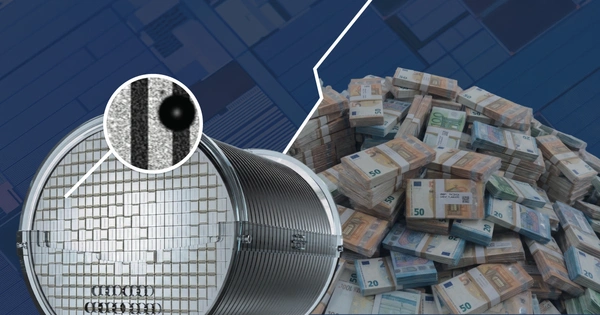
Starting Point: A Typical High-Volume Fab
Starting with a representative production scenario helps illustrate the financial impact. For example, consider a high-volume fab running at 730,000 wafer starts per year.
Wafers are typically processed in lots of 25. Due to throughput constraints, only a small subset (approximately four per lot) is reviewed manually. Decisions about the remaining 21 wafers are then inferred from this limited sample. The review process does not observe the full lot, but still determines its disposition. The review process does not observe the full lot, but still determines its disposition.
This structure is common across modern fabs. Inspection systems generate enormous volumes of valuable data, but review capacity does not scale at the same pace. Production decisions are often based on information from only a small sample of wafers. When only a small subset is reviewed, context is incomplete, creating ambiguity that propagates through production.
Reliance on inspection data alone is not enough. Review decisions require context to determine which anomalies matter and how they should influence lot disposition.
Where Yield Loss Occurs
When anomalies are identified in sampled wafers, the outcome is rarely isolated to those wafers alone. Decisions are applied at the lot level. If defects are confirmed in the reviewed sample, the remaining wafers in the lot are often treated conservatively.
The outcome depends on the binning rule used in the fab. For example, rules such as “any reviewed wafer defective” or “at least two of three wafers defective” can trigger lot-level holds based on a small sample. The probability of triggering such a rule depends on the underlying defect footprint, but the resulting action typically applies to the entire lot. So in a typical scenario:
- A lot contains 25 wafers
- Only 4 wafers are reviewed
- A defect found in the reviewed sample can trigger a lot-level hold
- The remaining 21 wafers may never be individually assessed
- If the lot is ultimately scrapped, good wafers can be lost alongside the defective ones
Good wafers may be discarded simply because they were never individually assessed. Over time, this creates a structural yield loss mechanism. At €1000 per wafer, this translates into a multimillion-euro problem embedded in daily operations.
Quantifying Yield Recovery Impact
So, how do fabs solve this problem, and what is the potential yield recovery impact? The answer lies in an AI-driven decision evidence layer that removes a structural inefficiency in decision-making. Inspection data from every wafer is transformed into structured, governed evidence that supports individual assessment.
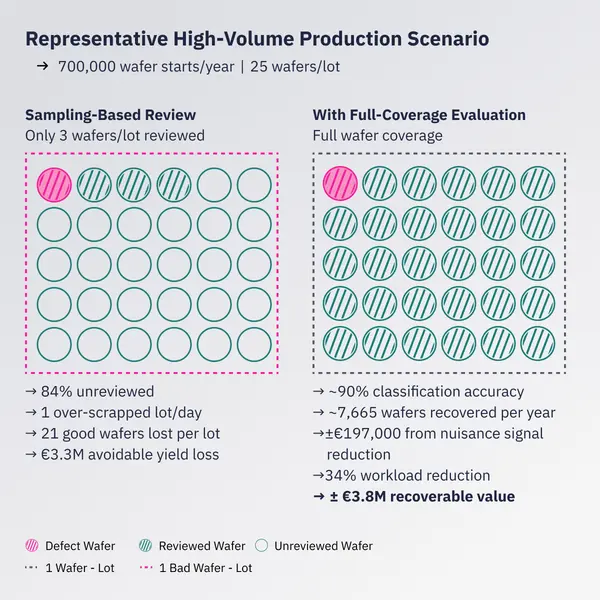
Rather than relying on lot-level inference from a small sample, reviewers receive context for every wafer, improving classification and decision consistency while reducing unnecessary holds. By replacing sampling-based inference with evidence-backed wafer-level assessment, a large share of this structural yield loss can be recovered. Assuming a conservative AI accuracy of 90%, this translates into approximately 7,600 recovered wafers per year, representing just over €3M in recovered yield.
Additional Sources of Value
The financial impact extends beyond yield recovery alone. Additional value comes from reducing nuisance-driven review and lowering manual review effort to reduce classification inconsistency. For example, a portion of inspection data corresponds to anomalies that do not affect functionality but still create decision uncertainty. By providing structured evidence, reviewers gain the context needed to distinguish these nuisance signals more confidently.
Ambiguity is removed, reducing the need for conservative binning that leads to unnecessary scrap. When localization, segmentation, and classification work together, however, teams gain better visibility into which signals matter, which do not, and where recurring patterns emerge. In this scenario, that contributes an additional ±€197,000 in recovered value.
There is also an operational effect. Manual review is resource-intensive and requires continuous staffing. By reducing the volume of cases requiring human intervention, evidence-backed AI-supported review allows review capacity to be reallocated. Even a partial reduction in manual workload can translate into meaningful efficiency gains and enable faster decision cycles.
This advantage is particularly relevant in high-throughput environments, where review capacity does not scale with inspection load and creates structural bottlenecks. The shift also allows experienced engineers to focus on higher-value tasks, rather than processing large volumes of routine classifications, resulting in ±€570,000 unlocked labor capacity value.
When these elements are combined, the financial implications are clear:
Ready to quantify your yield recovery opportunity?
While the exact value will depend on review coverage, binning rules, defect behavior, and wafer value, the underlying opportunity structure remains the same. To quantify your own yield opportunity, use our interactive ROI Calculator and discover the recoverable value in your own fab.

Strategic Implications Beyond the Numbers
The financial case is compelling, but the operational implications are just as important. A software-driven review layer enables wafer-level decision-making, reducing reliance on conservative assumptions.
This capability is especially relevant in automotive environments, where strict quality requirements amplify conservative decision-making, and in SiC and power devices, where higher defect variability increases ambiguity.
Classification becomes more consistent across shifts, tools, and fabs. Additional analytical capabilities improve visibility into defect behaviour and yield impact, enabling inspection to scale without introducing new review bottlenecks. Fabs can also increase AOI sensitivity without increasing downstream constraints.
This approach creates a structured decision record that supports root cause analysis, process control, and continuous model improvement. As more decisions are processed, performance can be monitored, with drift detection and targeted data capture sustaining value as conditions evolve. This improvement should not require changes to existing inspection systems or MES workflows; the value comes from improving how data is interpreted, rather than how it is generated.
From Sampling to Full-Coverage Review
As discussed, yield loss is not driven by defect density alone. It is impacted by how review decisions scale. As inspection outpaces human capacity, sampling introduces uncertainty, which in this context is not abstract.
Uncertainty is created because only a small fraction of wafers is observed. Decisions are made based on incomplete evidence, increasing the likelihood of conservative, lot-level actions.
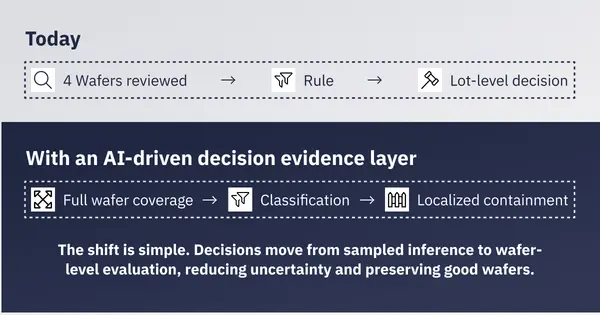
Instead of extrapolating from three wafers, inspection signals from every wafer contribute to structured decision evidence. Ranked classifications and historical production context provide reviewers with a far more complete understanding of defect behaviour before disposition decisions are made.
From Financial Model to Production Reality
The €3.8M scenario is one example based on a specific production profile. Yet the pattern is widely applicable. Wherever sampling drives decisions and uncertainty drives conservatism, there is recoverable yield.
Where a small number of reviewed wafers determines the fate of the entire lot, there is structural over-containment. This value is often hidden, distributed across thousands of small decisions made every day.
In the next article, we discuss how Robovision’s production-grade deep learning inspection layer is operationalized within the fab, providing predictable value over time. We discuss how this fits into existing production, with a review layer that operates on existing fab infrastructure and fully utilizes existing inspection investments.
Ready to improve yield loss from review bottlenecks? Let’s talk.
Or to learn more about replacing sampled decisions with full-coverage classification and recovering lost yield, explore our resources.
Quantify Your Own Yield Recovery Potential
In the meantime, to understand what the yield opportunity looks like in your production environment, the next step is to quantify it using your own parameters. We created an interactive ROI calculator to help you quantify:
- Sampling amplification
- Trigger probability
- Containment vs. true footprint
- Recoverable wafers and annual value
Discover in minutes:
- Current decision structure and its impact
- Over-containment volume
- Recoverable yield potential
- Annual financial upside from full-coverage review