The Hidden Cost of Defect Review Decisions
Date Section Blog
In high-volume semiconductor production, inspection does not create yield loss. Uncertain decisions on sampled wafers do.
As inspection systems become more sensitive, they detect more anomalies and generate more data than human reviewers can consistently classify. Under uncertainty, decisions become conservative, and good wafers are unnecessarily scrapped. The impact? A hidden, multi-million-euro cost per fab per year.
This article explores how inspection has outpaced decision capacity, why manual review introduces yield loss and operational bottlenecks, and how more data alone does not improve outcomes.
It also outlines the need for a shift in the review model, toward structured, evidence-backed decision-making that reduces uncertainty and recovers yield at scale.

The Operational Reality of Defect Review
In high-volume production, defect review decisions can account for millions of euros in recoverable yield per fab, per year.
Although process control and inspection are automated, defect review is still largely human-operated and inconsistent. The real cost appears when humans make decisions under uncertainty, which leads to conservative holds and unnecessary scrapping. When inspection systems flag anomalies, engineers must determine whether those signals represent actual defects or acceptable variation. If the reviewer is unsure, the safer decision is to treat the wafer conservatively, and good die may be discarded.
In most fabs, only a small fraction of suspect wafers can be reviewed in detail, yet decisions are applied across the full lot. The remaining wafers are never evaluated, only inferred. Any uncertainty on a few sampled wafers can drive lot-level actions such as shock-binning or inking, causing broader production holds than the actual defect footprint justifies. As demand for high-value segments such as automotive and high-power SiC increases, each wafer carries more value, driving up the cost of conservative decisions.
Inspection Has Outpaced Decision Capacity
These challenges stem from inspection and decision-making evolving at different speeds. In automotive and power semiconductor manufacturing, inspection capability has advanced to support near-100% quality coverage on critical process steps, detecting an increasing number of subtle and borderline anomalies. AOI sensitivity is increasing, finding more potential defects and detecting the most subtle variations on wafers. While these tools perform their roles well, the issues begin after the defect is detected.
The issue is not a lack of inspection data. It is the absence of structured decision evidence. Inspection systems generate signals, but reviewers are often left to interpret those signals without ranked classifications, historical comparisons, or other evidence that supports a confident disposition.

The result is manual processes that struggle to scale at the same rate as inspection capability. Review teams face growing workloads while production lines continue to accelerate. For many fabs, this review stage becomes a hidden constraint within the manufacturing flow, impacting yield and eroding margins over time.
Uncertainty Drives Yield Loss, Not Defects
Yield improvements translate directly into margin protection, particularly in high-volume production. Inspection flows are typically designed with this in mind. They focus on preventing defect escapes using AOI systems that are already extremely sensitive by design.
However, this sensitivity introduces ambiguity. AOI systems generate large numbers of false positives, nuisance patterns, and borderline anomalies. Ambiguity arises during classification, when an engineer is unclear whether a signal represents a true defect or an acceptable variation. In these cases, “unknown” categories often become catch-all bins.
When manual review lacks the evidence needed to assess borderline cases with confidence, the conservative option wins: engineers use high-severity bins and prefer scrap over uncertainty. Over time, this creates a systematic bias toward precautionary binning, where uncertainty is resolved by escalating severity rather than validating actual impact.
Good wafers are scrapped even when the anomaly has no impact on device performance. In sampling-based review flows, a conservative interpretation of a few reviewed wafers can lead to disproportionate yield loss across an entire lot. Small percentages of lost die across large wafer volumes soon add up.

At its core, this is a human capacity problem. As inspection sensitivity increases, more ambiguous anomalies are detected. Human review capacity does not keep pace, and reviewers often lack the decision evidence needed to confidently distinguish true defects from acceptable variation. When this gap widens, it translates directly into millions of euros in lost yield per fab each year, with a measurable impact on P&L.
Ready to improve yield loss from review bottlenecks?
The Yield Bottlenecks of Manual Review
When looking at P&L, yield loss is often traced back to production constraints such as lithography capacity, tool utilization, or cycle time. As inspection sensitivity increases, more fab leaders recognize what is often described as the Throughput Paradox. More anomalies are detected, so the burden shifts from detection to interpretation, and manual review becomes the bottleneck.
Manual classification introduces operational variability that is difficult to control. Reviewers across a 12-hour shift may struggle to consistently distinguish a nuisance from a killer defect. Engineers can evaluate thousands of inspection images during a single shift, which also leads to fatigue and inconsistent judgment.
Additionally, the same anomaly can lead to different yield decisions. Differences in experience between reviewers or available context can influence how defects are interpreted, while separate shifts may reach different conclusions when assessing similar images.
Reviewers also have limited time to evaluate each case. During production ramps, this pressure intensifies, leading to several operational challenges.
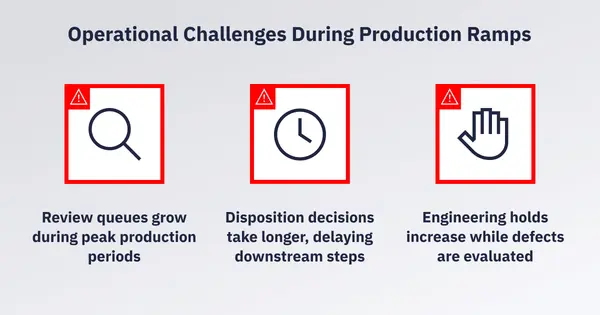
When workloads peak, decision thresholds tighten. The result is conservative classification and slower decision cycles, in a production environment that depends on speed and consistency. At the same time, the volume of inspection data continues to grow. The decision-making process does not improve, driving ongoing losses in yield and margin.
Massive Inspection Data, Limited Decision Intelligence
These issues are compounded by AOI images, classification bins, review history, and yield data that quickly accumulate across production environments. Yet despite collecting terabytes of data, fabs struggle to understand why yield changes. Data is not the limitation; the issue is how decisions are made from it.
Inconsistent Annotation Quality
Human classifications can be inconsistent and inaccurate, reducing the reliability of the data used to support future review decisions. The same defect may be classified differently by different reviewers, with incorrect decisions compounding over time.
No Systematic Learning From Reviewer Behavior
Engineering often lacks tight feedback. Review decisions do not improve AOI models fast enough, and root causes are not linked to classification trends.
Weak Link Between AOI Findings and Final Yield Impact
Anomalies are reviewed and classified, but their relationship to final sort-yield remains unclear. It becomes difficult to distinguish killer defects from process-induced nuisance, leading to false-scrap revenue loss.
Lack of Visibility Into Decision Patterns
Thousands of review decisions are made across shifts and production lines, but the reasoning behind them is rarely captured as reusable data. Inspection datasets grow, but decision logic remains invisible.
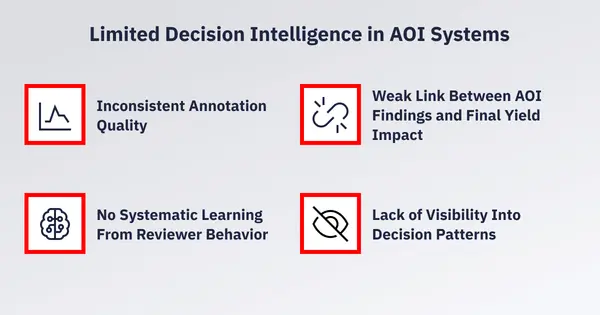
Together, these challenges highlight that inspection data alone does not improve yield. As inspection datasets grow, decision quality does not improve, making it difficult to protect margins and manage P&L performance. What is missing is a governed decision evidence layer that transforms inspection signals into actionable production evidence. By combining inputs such as ranked classifications, defect measurements, drift indicators, and auditable decision context, manufacturers can support more confident and consistent review decisions while continuously improving decision quality over time.
Closing the Gap Between Detection and Decision
Reducing uncertainty in the defect review stage allows manufacturers to recover good wafers that might otherwise be scrapped, reduce unnecessary lot-level actions, and improve the economic return of existing inspection infrastructure. In high-volume environments, this translates into a multimillion-euro impact per fab each year. The next step to unlocking this value requires a shift in the review model.
Instead of relying on broad manual sampling and operator interpretation, the review process should be supported by structured decision evidence. In this model, not every anomaly requires human attention. Many signals represent nuisance or acceptable variation and do not need to influence lot-level decisions.
In our next article, we explore how structured decision evidence, built from capabilities such as AI-driven classification, enables more consistent review at scale. You can also quantify recoverable yield based on your own fab conditions, using our new ROI Calculator.