The Dock Knew. (But the Network Found Out Six Weeks Later).
Date Section Blog
A misread at receiving, a chargeback in the inbox, a call from a retailer. The readings were on the floor the whole time.
The first indication in a logistics event is almost never an alarm. It is the third manual re-key on a misread carrier label at 6 AM. A mixed pallet that ships, arrives, and turns into a chargeback line item six weeks later. A wrap pattern that holds at one DC and slips at another, with nothing connecting those readings until a retailer calls the network. By the time a conversation about it reaches the CEO, it has gone on for weeks.
Six weeks before the incident report on Inbound Dock 7 was written, the OCR had started missing the new carrier label print run. Operators were re-keying, logging the cause as "print quality," and pushing the load through. By the third Monday, the throughput tax was four weeks deep. The report named the cause. It could not return the dwell time.
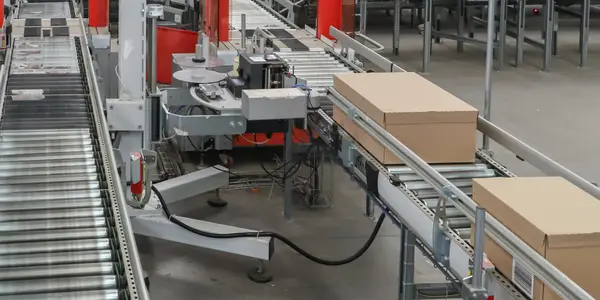
The chargeback on the CFO's desk arrived eight weeks after the first misclassified pallet shipped. By then, the mixed-pallet classifier on Outbound 3 had been flagging SKU mismatches on the new shrink-wrap film for thirty-one days. Nobody had connected the curve to the film batch or to the affected retailer accounts.
The call to the CEO came on a Thursday morning. DC2 had been watching a slow drift in wrap stability for three weeks, and DC4 had logged a similar pattern. The network saw nothing until the retailer made it see, after more than 600 pallets had shipped to four customers across three countries.
Three roles. Three readings the floor was already producing. The same condition underneath each one: the inspection was running, and nothing was keeping it aligned with what the dock and the lanes were actually doing.
Ready to close the gap between the system and your dock? Let’s talk.
Replacing the equipment relocates the problem
The conversation that follows usually turns to equipment: new OCR cameras, more sensitive pallet integrity inspection, a clean modernization budget. In most cases, that targets the wrong layer.
The OCR at Inbound 7 could read the new label format. The classifier on the CFO's lane was sensitive enough to flag a substituted SKU. DC2 was already monitoring pallet stability. The detection layer was not the problem.
The missing piece sits above detection. No baseline against this print supplier on this carrier format. No flag when a new shrink-wrap roll shifted reflectivity past the classifier's envelope. No audit trail linking the rising no-read pattern to the label batch.
A new system arrives calibrated for today. It will still drift next quarter. Replacement moves the gap forward six months.
What the G&OT Layer brings to the floor
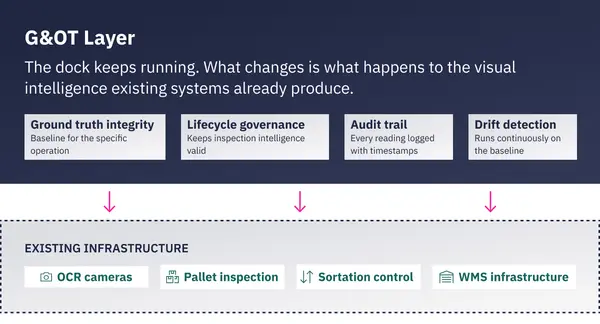
Robovision deploys the Governance and Operational Technology (G&OT) Layer in logistics environments today. It connects to existing OCR cameras, pallet inspection, sortation control, and WMS infrastructure. The dock keeps running. What changes is what happens to the visual intelligence existing systems already produce.
It begins with Ground Truth Integrity: a baseline for the specific operation. The OCR contrast envelope for this carrier label on this print supplier. The pallet integrity envelope for this wrap pattern. The mixed-pallet classification profile for this SKU mix. The anomaly detection profile for inbound damage on this carrier route. Until that exists, deviations are numbers. Once it does, they are readings that can be traced and acted on.
Drift Detection runs continuously on top of that baseline. A new shrink-wrap supplier shifts reflectivity. The classifier sees it. The G&OT Layer flags that the lane has moved outside the validated envelope, and the reading reaches the dock lead before the manual exception spiral starts.
The Audit Trail logs every reading: model version, parameters, deviation against the baseline. When the CFO asks when the operation knew the misclassification rate was a problem, the answer sits in the Audit Trail with timestamps. As ASN accuracy and traceability mandates tighten, this is the difference between a defensible chargeback and one that is not.
Lifecycle Governance keeps the inspection intelligence valid as conditions change. Model updates go through Operational Acceptance Testing against the current baseline before reaching production.
From one DC to a network
Fleet-wide governance puts the same G&OT Layer at every site: same baseline, same drift logic, same audit trail structure. Instability at one DC triggers a review at every DC running the same setup.
When a retailer or carrier asks for documented evidence of quality governance, the answer is the same at every DC. Cross-site variance becomes visible as evidence, not as field reports from different DC managers.
The integration does not require a dock door to be taken out of service or a rip-and-replace capital program. The G&OT Layer sits atop the existing camera and WMS footprint.
What changes?
None of the three events was a hardware failure or a process the quality team missed. Each was vision intelligence running without the ability to keep itself aligned with the floor.
Variability across multiple docks, carriers, and a shifting SKU mix does not disappear. What changes is whether the operation knows what is happening on the floor in time to act, or finds out from a retailer six weeks later.
The next carrier label format update is already in the rollout pipeline. The next print supplier switch is on someone's desk now. The question is whether the inspection intelligence above the dock will drift through it, or hold.
That capability is in production today.
--
Last week's articles elaborated on three business leadership perspectives and how each affects specific areas of the enterprise. Read the perspective that fits your role in Three Readings of the Same Number.