Before the Alarm. Before the Invoice. Before the Call.
Date Section Blog
Three packaging events, one structural gap, and the layer that closes it.
The COO on Line 5 did not need a better incident report. The report arrived, named the root cause, and was filed. What it could not prevent was the six weeks of buffer time that crept into every changeover after it. Operators learned not to trust the errant SKU. The throughput cost never showed up on a single breakdown report.
The CFO did not need a more sensitive vision system. The vision system on Line 3 was already flagging the deviation. What was missing was anything that linked a rising reject trend to a new label batch, to a compliance risk category. And to the retailer commitments on the affected SKUs. At least, early enough for someone with authority to act on it before the retailer did.
The CEO did not need better plant-level monitoring. Plant 2 had monitoring. Each plant watched its lines against its own thresholds. No plant could translate a local reading into a network-level alert before the million plus units were in scope across several countries.
Three roles. Three events. The same condition underneath each one: the inspection on the floor was running, and no element or component was keeping the inspection aligned with what the floor was actually doing.
Replacing the equipment relocates the problem
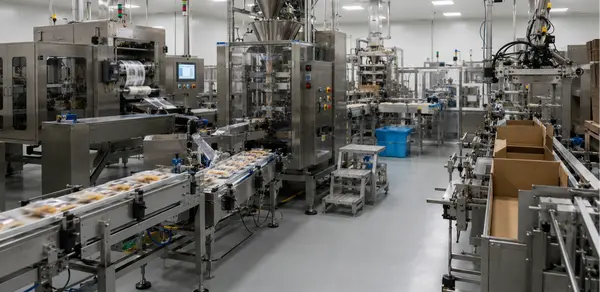
The first conversation that follows an event like the ones above is usually about equipment. Newer cameras, more sensitive inspection, a clean modernization budget. But in most cases it is a discussion that targets the wrong layer.
Line 5 had a vision system capable of detecting the seal anomaly. The label inspection on the CFO's line was sensitive enough to catch a 2mm skew. Plant 2 was already running camera-based monitoring on the affected SKUs. The detection layer was not the problem.
The missing piece sits above detection. No baseline against this specific SKU on this specific film. No mechanism to flag that a new film supplier has shifted reflectivity past the envelope the inspection was trained on. No audit trail linking a rising reject pattern back to the label batch number that introduced it. The intelligence was running, but the infrastructure to keep that intelligence aligned with the floor was not.
If a new system arrives calibrated for today, it will still drift next quarter. Replacement does not close the gap. It moves it forward six months.
Ready to close the gap between the system and your line? Let’s talk.
What the floor actually needs
The COO on Line 5 needed the first thirty minutes after a changeover to be governed against the baseline for that SKU on that film. The reject-rate dashboard already existed. What was missing was a validated envelope: this restart is inside it, or it is not. With a film supplier change in the same week, the inspection has to know it is now running against a surface profile it has not been validated on, and the line lead has to see that on the HMI before the third manual adjustment.
The CFO's facility needed the rising reject pattern on the new label batch tied back to that batch number, with the compliance exposure on the affected SKUs surfaced in the same view. The reject curve was visible in the existing dashboard. What was missing was the part that connects the curve to a batch-level deviation and to the retailer commitments it touches, with the audit trail to show when the operation first had reason to act.
The CEO needed Plant 2's drift to be visible in the same framework as Plant 1, Plant 3, and Plant 4. A mono-material introduction that produces instability at one plant has to trigger a review at every other plant running the same material, before the deviation propagates across the SKU footprint. What is visible at one site has to reach the network within hours, with the same baseline methodology behind the reading at every site.
Three different roles. The same underlying requirement.
Introducing Governance and Operational Technology (G&OT)
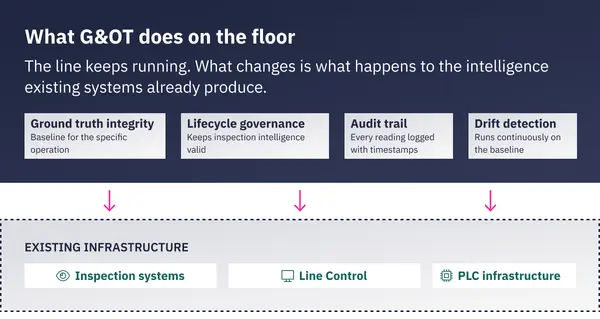
Today, Robovision deploys Governance and Operational Technology (G&OT) in packaging environments. It connects to existing inspection systems, line control, and PLC infrastructure. The line keeps running. The only change is what happens to the intelligence existing systems already produce.
It starts with Ground Truth Integrity: a baseline for the specific operation, not a generic industry curve. The seal envelope for this format on this film at this line speed. The label alignment envelope for this specific tray geometry. The clean-restart profile for this SKU on this line after this changeover sequence. Until Ground Truth Integrity exists, deviations are numbers. Once it does, deviations are readings that can be traced, scoped, and most importantly, acted on.
Drift Detection runs continuously on top of that baseline. A new film supplier shifts the surface reflectivity profile. The inspection sees it. The G&OT Layer flags that the line has moved outside the validated envelope. The reading reaches the line lead before the adjustment spiral starts, and reaches the plant director within the shift if drift persists.
The Audit Trail logs every reading: the model version active at the time, the parameters in force, and the deviation against the baseline. When the CFO asks at what point the operation knew the label batch was a problem, the answer sits in the Audit Trail with timestamps. As retailer compliance and PPWR-driven material changes keep tightening, this is the difference between a quality event that can be defended and one that cannot.
Lifecycle Governance keeps the inspection intelligence valid as packaging conditions change. Model updates go through Operational Acceptance Testing against the current baseline before they reach production. A retraining cycle that improves performance on one SKU and regresses marginally on another is known before it reaches the floor, not after.
What that means for the packaging industry
For a plant director, this changes the risk calculus on a modernization project. The integration does not require a line stoppage. It does not require a rip-and-replace capital program. The G&OT Layer sits atop the existing inspection footprint, with the lifecycle discipline that keeps it trustworthy after the integration is done.
The CEO was running four plants, more than 250 SKUs, and retail partners whose compliance specifications had tightened every year for five years straight. Each plant watched its own lines against its own thresholds. The drift at Plant 2 was visible inside Plant 2, but not evident across the network until the retailer made the organization aware.
Fleet-wide governance puts the same G&OT Layer at every site: same baseline methodology, same drift logic, same audit trail structure. A mono-material introduction that creates instability at one plant triggers a review at every plant running that material, with the same evidence behind the call.
When a retailer or a regulator asks for documented evidence of quality governance, the answer is the same at every plant, because the layer that produced it is the same at every plant. Cross-site performance variance becomes visible as evidence, not as field reports from different plant managers.
The three events came from three different parts of the business. An adjustment spiral on Line 5 the COO knew would repeat. A chargeback the CFO had to explain six weeks later. A Thursday morning call the CEO took on a decision she had approved in good faith.
None of them was a hardware failure. None was a process the quality team missed. Each one was vision intelligence running without the ability to keep the intelligence aligned with the floor as packaging conditions changed.
The G&OT Layer puts that alignment in place. Baselines specific to the line, the SKU, and the format. Drift Detection that surfaces a deviation as a reading the line lead can act on. An Audit Trail that answers the question before it is asked. Lifecycle Governance that keeps the intelligence valid as materials, suppliers, and formats change underneath it.
The promise is not zero defects. The variability across multiple lines, multiple formats, and a shifting material mix does not disappear. What changes is whether the operation knows in time about what is happening on the floor so they can act instead of finding out from a retailer six weeks later.
The next material change is already in the procurement pipeline. The PPWR roadmap is not slowing down. The next supplier switch is on someone's desk now. The question is whether the inspection intelligence above the line will drift through it, or hold against a baseline that has been validated for it.
That capability is in production today.
--
Last week's articles elaborated on three business leadership perspectives and how each affects specific areas of the enterprise. Read the perspective that fits your role in Three Readings of the Same Number or try the Packaging ROI Calculator.